 atestate.ro
Roman Influence in The British Isles






Roman Influence in The British Isles
12
€
Cuprins atestat
1.Introduction .......... page 3
2.Roman Empire-Rise and Fall of a Titan .......... page 5
3.The Britons-First contact with the Romans .......... page 8
4.Boudicca’s revolt .......... page 13
5.The Caledonian campaign .......... page 15
6.Romanization of Celtic cults. .......... page 19
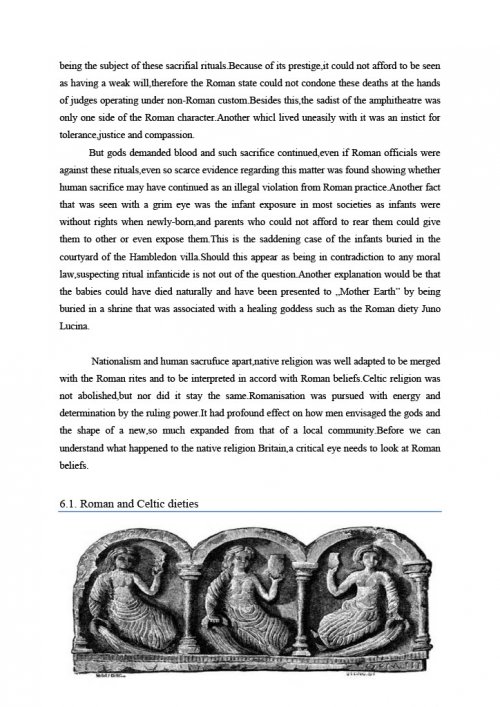
6.1. Roman and Celtic dieties .......... page 23
7.Last century of Roman rule .......... page 26
8.Bibliography : .......... page 31
Extras din atestat
They came,they saw,they conquered.The Romans have built a lasting legacy which can be observed even now,being able to resist the tumultuous fate of other civilizations caught in the history maelstrom.
The innovations strech from technology,town planning,architecture,language,we can also talk about planting the seed for a future national identity,thus the Roman Empire was able to enroot itself in the culture of both West and East European nations,nonetheless,their influence in the British Isles has no doubt changed the course of its rhytm of development as a nation,creating favourable conditions for the birth of the Medieval state England,defining itself after the Saxon element has come into play.
This subject has attracted the attention of many history enthusiasts,and I would not stop there,knowing as humans what our ancestors did will do nothing but enrich our understanding of the way people perceived matters such as war,ethics,politics,religion and society. Learning from their mistakes,even if we are in the 21st century,or better yet realising where they went wrong can make a change for the best in nowadays life.
Yet,to what extent did the Romans influence the British? In regards of the language usage, for hundreds of years after the fall of the Roman Empire, Latin and Greek were used throughout Europe as the languages of education and knowledge. European scholars wrote their works in them and educated men corresponded mostly in Latin, with some Greek, with other educated men of their own or different nationalities.
We must remember that the Romans were in Britain for nearly 400 years and left a strong influence on the local speech, so that the Anglo-Saxons, when they arrived, also picked up and incorporated a great many Latin words into their own language. An everyday Anglo-Saxon-sounding word; such as, plum comes from the Anglo-Saxon pluma; butpluma is merely an Anglo-Saxon mispronunciation of the Latin pruna (plum) from Greek, prounon, a later form of proumnon; which, by the way, comes to us also, through the French, in the form prune. Again, take the familiar word bishop which is derived from the Anglo-Saxon biscop; but biscop in its turn is only an amputated form of the Latin episcopus (overseer, superintendent.
Thus,the Romans were able to stand the test of time ,from a specific point of view,not by having rewarding military campaigns,but by leaving their technological,civilisational mark on the nations they’d encountered.
Bibliografie atestat
1.Roman Britain and English Settlements-Robin George Collingwood
2.History of the World-J.M. Roberts
3.Celtic culture,a historical encyclopedia Vol.1,Vol 2-John T. Koch
4.People of Roman Britain-Anthony Richard Birkley
5.Roman Britain:a very short introduction-Peter Salway
6.Religion in Roman Britain-Dr Martin Henig
7.The Romanization of Britain:An Essay in Archaeological Interpretation-Martin Millet
8.Roman civil and military architecture in the province of Britain:aspects of patronage,influence and craft organization –T.F.C Blagg
9.http://en.wikipedia.org/wiki/Roman_Republic
10.http://en.wikipedia.org/wiki/History_of_the_Roman_Empire
11.http://en.wikipedia.org/wiki/Western_Roman_Empire
12.http://en.wikipedia.org/wiki/Boudica
13.http://www.romanbritain.freeserve.co.uk/endromanbritain.htm
14.http://www.sacred-texts.com/cla/jcsr/dbg6.htm